
Why Demand for Korean Speaking Practice Is Growing in Japan
As the global Korean education market grows rapidly, learners in Japan are moving beyond understanding toward actually speaking.

The number of people learning Korean is growing rapidly around the world. Japan sits at the center of that trend, and learner demand is already moving beyond reading and listening toward actually speaking Korean out loud.
How fast is the Korean education market growing?
According to market research, the global Korean language education market is expected to maintain a 25.1% compound annual growth rate and reach around 67 billion USD by 2034.1
One of the biggest drivers behind this growth is the global expansion of Korean content. As K-pop, dramas, and films spread worldwide, more learners want not only to enjoy that content, but also to understand it directly and speak the language themselves.
Why Japan?
Japan is a major market that accounts for about 23.2% of the global Korean education market.1 Thanks to geographic proximity and active cultural exchange, interest in learning Korean has remained strong for years.
What is especially important is the level of the learners. According to recent research, about 78% of Korean learners in Japan consider themselves intermediate or above.2 That means this is not just a beginner-heavy market. It is a market filled with learners who have already spent real time studying and now want to go further.
What learners want now: speaking
In the same study, about 92% of Korean learners in Japan said they want to improve their speaking ability.2
That number tells us something very clear. Many learners already understand Korean and can read it to some degree, but they still feel they do not have enough chances to actually speak, respond, and practice in realistic situations.
There is still a large gap between Korean you can understand and Korean you can actually speak.
Interest is turning into action
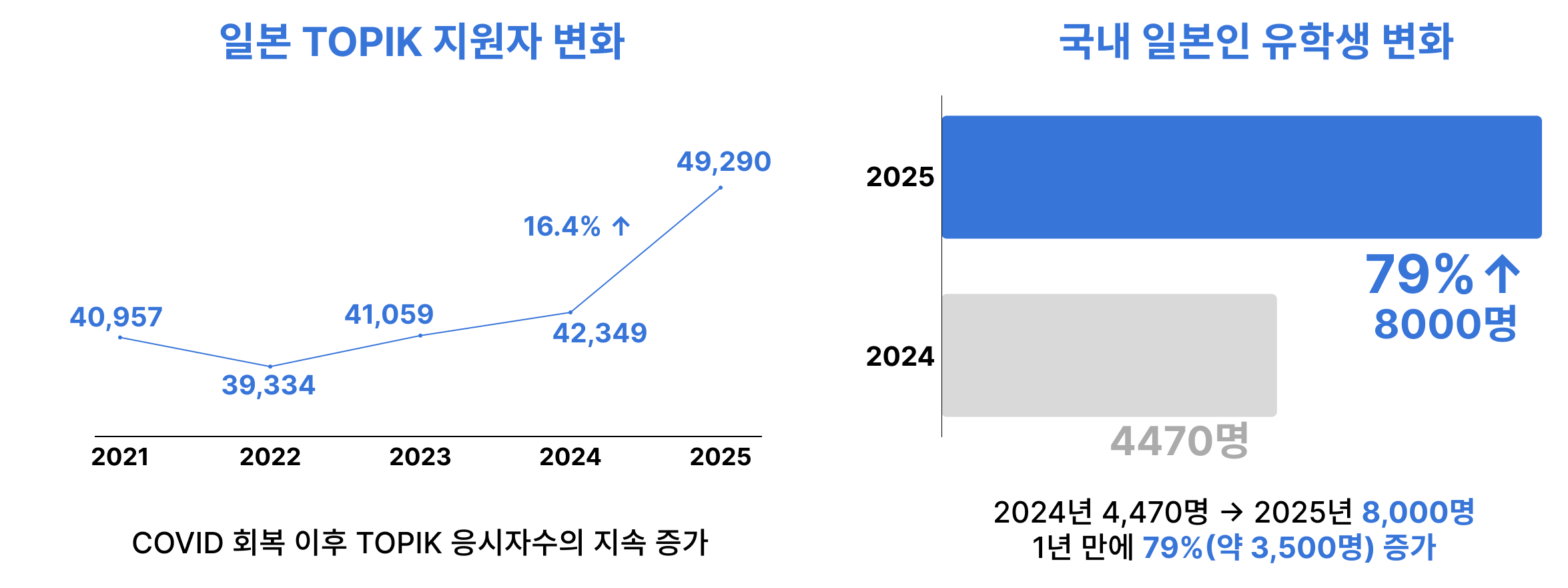
This trend is visible in real-world data as well.
The number of TOPIK (Test of Proficiency in Korean) applicants returned to growth after the pandemic and recorded about 25% year-over-year growth in 2025.3
The number of Japanese students studying in Korea is also rising quickly. In 2025, the figure reached around 8,000 students, up about 79% from the previous year.4
This means Japanese learners are moving beyond passive cultural consumption and stepping directly into learning, testing, and real-world experience.
What this market needs
The Korean learning market in Japan is now at an interesting turning point. The learner base is already large, and learner level has already risen. What is missing is not simply more grammar explanations or more content.
What is missing is the chance to actually speak.
Speaking is one of the hardest parts of language learning to practice alone. To use an expression from a textbook in a real conversation, learners need repetition, response pressure, and feedback. Those opportunities are still limited. It is not easy to regularly meet native Korean speakers in Japan, and it is not easy to keep attending language schools long term either.
If 92% of learners want speaking practice, that also means the current supply of speaking opportunities is not keeping up with demand.
This is exactly where Malang begins.
Malang is built around one idea: learners should not stop at understanding Korean expressions. They should be able to pull those expressions out and use them in real conversation.
By combining short-form learning content, AI conversation, and roleplay, Malang aims to provide a flow where learners first understand expressions and then actually try speaking them in realistic situations.
Building a learning experience that connects understanding to speaking is the problem Malang is trying to solve.
-
Global Market Insights, Korean Language Learning Market Report 2025
-
Lee Kyunghee, Lee Dongjun, Cho Hyeonyong (2025), “A Study on Learner Perceptions of Korean Speaking Assessment in Japan”, Korean Language and Culture Studies
-
Official TOPIK website, applicant statistics
-
Japan Student Services Organization (JASSO), affiliated with Japan’s Ministry of Education